SHARE:  

View as webpage

LOTL-header_2021.png

UNIVERSITY OF ARIZONA

JAMES E. ROGERS COLLEGE OF LAW


JANUARY 28, 2026

UPCOMING EVENTS

Feb. 9

Mundheim Speaker Series with Michele Coleman Mayes

Feb. 24

Book Talk with Spencer May ('26)

Feb. 26

Employer Deadline for 2026 Law Grads Interview Program

Greetings,


With midterms approaching later in 2026, election law is sure to be in the news around the country. I couldn’t think of a better moment to welcome Ned Foley, a nationally recognized expert on election law and constitutional governance, back to campus as a visiting professor. In his second long-term visit to Arizona Law, he will teach our students and engage our community on important and timely issues.


Welcome back, Professor Foley!

Read on,

Jason

FEATURE

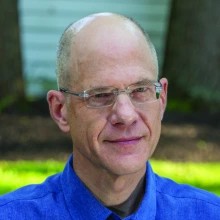
National Election Law Scholar Edward Foley Joins Arizona Law as Visiting Professor in Spring 2026

Edward Foley, a nationally renowned expert in election law, has joined our faculty as a visiting professor in Spring 2026. His appointment is made possible through a grant from the Thomas R. Brown Foundations, supporting his teaching and public engagement at Arizona Law over the next three years.


Professor Foley, who holds the Ebersold Chair in Constitutional Law at The Ohio State University’s Moritz College of Law, is widely recognized for his scholarship on election law, constitutional governance and democratic reform. He is a former Ohio Solicitor General; a contributing columnist for SCOTUSblog, including his recurring Justice, Democracy, and Law column; and reporter for the American Law Institute’s Project on Election Administration.


During his residency, Professor Foley will teach a course on election law, open to JD students and focused on topics including voting rights, election administration, redistricting and constitutional challenges. In addition to classroom teaching, Foley will participate in faculty workshops and serve as a featured speaker at the Rehnquist Center’s National Conference of Constitutional Law Scholars. His visit will include a public lecture on Monday, March 23, with broad promotion through livestreaming and community engagement efforts across Southern Arizona and beyond.


This is not Professor Foley’s first time engaging with the Arizona Law community. During a previous visit, he delivered a series of standing-room-only lectures and participated in vibrant faculty and public discussions on the future of U.S. elections and the rule of law.


See the full story here.

FROM THE COLLEGE

Prof. Tara Sklar on Telehealth Policy

Six years after the COVID pandemic, the virtues of remote health care are clear: Allowing patients to visit with their providers via phone or video call often means better access to health care for patients, including those in rural communities and those who struggle to leave their homes.


But the laws that regulate telehealth have not kept pace with its rise and demand. Since the pandemic, Congress has funded telehealth largely on a stopgap basis, temporarily extending COVID-era flexibilities more than a dozen times in the last few years. Each time, the extension provides only temporary funding to the Centers for Medicare and Medicaid Services — the nation’s largest funder of telehealth services.


The newest deadline for Congress to act on telehealth policy — the 15th deadline set on this issue since the COVID pandemic — is Jan. 30.


In a recent article in the New England Journal of Medicine, Tara Sklar, faculty director of the Health Law & Policy Program, together with co-author Barak Richman of the George Washington University, argues that the temporary funding measures for telehealth are not helping patients.


Professor Sklar discussed her article, federal telehealth policy and the human impact in a Q&A with the University of Arizona. Excerpts are below. The full article is available here.


Q: What’s at stake if this deadline comes and goes with no action from Congress?


A: What makes telehealth accessible is that you can do it from your home — or, really, a patient could do it from anywhere. So, first and foremost, if the waivers don’t come back into place, it would restrict telehealth to certain geographic areas, where it has to be a rural area or an area with a health professional shortage. Medicare beneficiaries who don’t live in those geographic areas will not be covered by Medicare for telehealth services.


Q: Why is it such a thorny issue for Congress?


A: The Congressional Budget Office has a really high price tag associated with these telehealth visits. They say it’s going to cost the Centers for Medicare and Medicaid Services as much as $4 billion over the next two years if we renew these waivers because people will get care perhaps more frequently. Many have also made the argument that patients are getting care in a more timely manner, so it’s saving costs later on, meaning that it’s still high-value care.


But I think the reality is — and why I co-authored the piece — that we have to separate out these telehealth flexibilities from the overall budget appropriations bills. Otherwise, it seems likely that there will continue to be potential government shutdowns and these impasses disrupt care, and the Medicare telehealth flexibilities are a victim of that.


Q: What’s the human cost of not having comprehensive telehealth policy?


A: The stories that break my heart are the ones where a Medicare beneficiary has dementia and getting out of the house for a 15-minute visit is just harrowing. I worked with a geriatrician at the University of Virginia on a blog post, and in it, she describes what it’s like to go to see the doctor if you’re older and live either in a rural area or have any kind of severe cognitive impairment. It’s not just the Medicare beneficiary — it’s their loved ones, it’s their time away from work, from caring for children, it’s time away that is not easy to find.

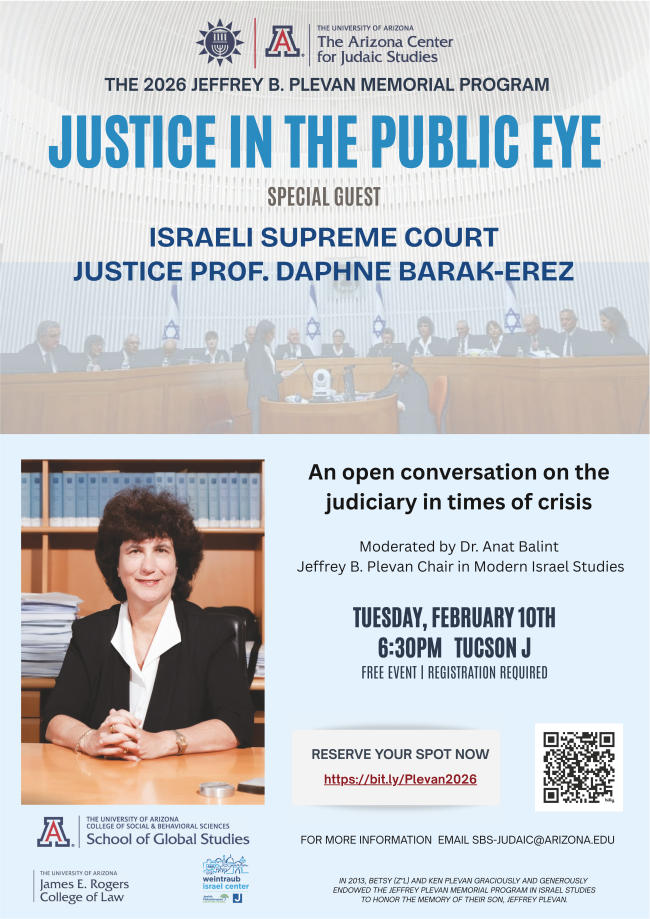
Israeli Supreme Court Justice to Speak on “Justice in the Public Eye”

Justice Professor Daphne Barak-Erez, a distinguished member of Israel’s Supreme Court since 2012, will be the guest speaker for the 2026 Jeffrey B. Plevan Memorial Talk, hosted by the Arizona Center for Judaic Studies in collaboration with the College of Law.


Event: The Jeffrey B. Plevan Memorial Talk 2026 Presents: A Special Talk on Judiciary in Times of Crisis, Justice in the Public Eye, a Conversation with Israeli Supreme Court Justice Prof. Daphne Barak-Erez

When: February 10 at 6:30 p.m.

Where: Tucson JCC (3800 E. River Road, Tuscon)

Who can attend: Open to the public; registration is required


This public conversation will be dedicated to the challenges faced by the judiciary in Israel and worldwide amid a polarized political climate and a changing media environment. The event, moderated by the inaugural Jeffrey B. Plevan Chair in Modern Israel Studies, Dr. Anat Balint, offers Tucson audiences a rare opportunity to hear firsthand insights from a leading jurist on the role of courts in democratic societies — particularly during times of political and social upheaval. 


Justice Professor Barak-Erez is recognized internationally for her scholarship and jurisprudence in constitutional law, administrative law and human rights. Her work reflects a deep commitment to democratic governance, judicial integrity and the protection of civil liberties—issues that have become increasingly central in today’s global political climate.


This event is free and open to the public; advance registration is required.


For more details, please contact Jackie Schmidt: jan1@arizona.edu at the Arizona Center for Judaic Studies.

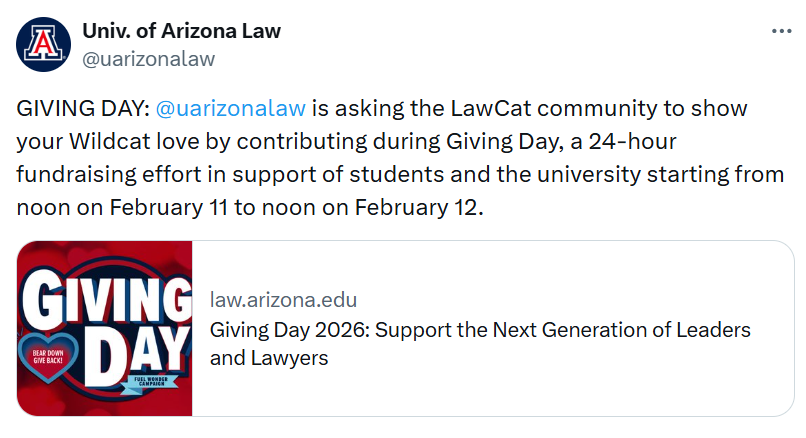
Giving Day is Coming Feb. 11–12: Support Arizona Law Students

University of Arizona Law is asking the LawCat community to show your Wildcat love by contributing during Giving Day, a 24-hour fundraising effort in support of students and the university starting from noon on February 11 to noon on February 12.


This year, every Giving Day gift to University of Arizona Law is focused on supporting our students. Your generosity ensures that we are able to train the next generation of leaders and lawyers and allows us to provide a modern, nimble legal education of the highest quality. A legal education is a life-changing experience, and with your support, we can give our students the resources they need to transform their passions and skills into fulfilling careers.

IN THE NEWS

Only electoral reform, not the Supreme Court, can protect against an American Caesar

SCOTUSblog, by Ned Foley

Do You Have News?


Your success is the college’s success and we want to celebrate with you! If you have landed a new job, received an award or recognition, stepped into a leadership role or have good news in general, let us know.

X, @uarizonalaw

I started this week’s newsletter on the subject of election law, followed by telehealth law and policy and Professor Sklar’s scholarship and practical perspective on the issue.


This week and every week, we are privileged at Arizona Law to engage with experts on the many intersections between law and the national conversation.

Onward,

Jason

Facebook      Twitter      Instagram      YouTube