SHARE:  

View as webpage

LOTL-header_2021.png

UNIVERSITY OF ARIZONA

JAMES E. ROGERS COLLEGE OF LAW


MARCH 25, 2026

UPCOMING EVENTS

Apr. 3

A.I.: American Indian Governance in the Age of Artificial Intelligence

Apr. 8

2026 Haury Indigenous Leadership Awards Celebration

Apr. 13

Can Electoral Reform Save American Democracy? A Conversation on Election Law

Greetings,


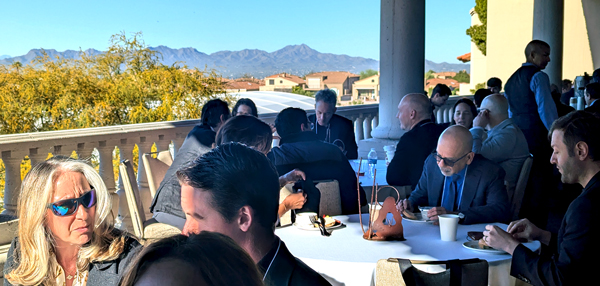
For two days in March, top constitutional scholars from around the country converged upon Tucson to share insights on issues of pressing and far-reaching impact. This week we feature that event: the eighth edition of the National Conference of Constitutional Law Scholars.

Read on,

Jason

FEATURE

2026 National Conference of Constitutional Law Scholars Tackles Issues of Executive Power and Judicial Precedent

Constitutional scholars discussed executive power, originalism, judicial precedent and other themes in a series of wide-ranging discussions during the eighth annual National Conference of Constitutional Law Scholars on March 6 and 7, 2026, at the Westin La Palma Resort & Spa in Tucson.


The event coincided with the 20th anniversary of the William H. Rehnquist Center on the Constitutional Structures of Government at Arizona Law, which sponsors the conference.


The conference featured Stanford Law Professor Mila Sohini as the keynote speaker, discussing “The Strange Career of Judicial Restraint.” Sohini addressed what she called “remedy skepticism,” or the reluctance of courts to provide remedies for violations of constitutional rights. She traced the current strain of remedy skepticism to the conservatism of the Reagan era, though she argued that it is not inherently a conservative or liberal ideal.


Sohini warned against narrowing the availability of remedies for constitutional violations in light of broadening executive power. “What happens after a court holds or has very good reason to think that what a government officer is doing is against the law?” she asked. “What kinds of remedies can a court give?”


The conference has come to serve as what Rehnquist Center Director Andrew Coan calls “a kind of annual meeting for the field of constitutional law” that extends beyond the formal agenda to the informal conversations among leading national experts. “It is a special point of pride that the conference continues to foster civil and constructive dialogue among persons of fundamentally different points of view,” said Coan. “The Rehnquist Center has made all of this possible and put Arizona Law on the map as a hub for cutting-edge constitutional law debate and scholarship.”


See the full story here.

FROM THE COLLEGE

The Journal of Appellate Practice and Process Publishes Winter 2026 Issue

Arizona Law and the National Institute for Trial Advocacy have released the Winter 2026 issue of The Journal of Appellate Practice and Process (Volume 26, Issue 1). The articles in this issue reflect and address changes to the practice of law.


“From social media, to changes in the use of logic, to how we write and how government lawyers do their jobs, we have come a long way in the practice of law,” writes Journal Editor-in-Chief Tessa L. Dysart, assistant vice provost of Native American Initiatives at the University of Arizona and assistant director of legal writing at Arizona Law.    


The issue begins with an article from Judge Stephen Louis A. Dillard of the Georgia Court of Appeals, in which he discusses how the public’s perception of judges has changed in recent years, with the public demanding more accessibility and transparency from judges. He argues that judges and courts should be more transparent with the public through the use of social media.


Gurney F. Pearsall III looks at how lawyers can use logic to form stronger legal arguments. Radhika Kattula writes about the changing role of the Solicitor General of the United States. Finally, Professor Christina M. Frohock reviews Professor Jill Barton’s book The Supreme Guide to Writing, which outlines the Justices’ writing preferences on matters of grammar and style.


For questions about The Journal of Appellate Practice and Process email Editor-in-Chief Tessa L. Dysart at tdysart@arizona.edu.  

Orbach Discusses Shift in California Antitrust Law

Robert H. Mundheim Professor of Law and Business Barak Orbach recently joined a panel of experts for a Tech in Courts virtual series from Washington Legal Foundation and TechFredom titled, “A Shift in California Antitrust Law: The State’s Single Firm Conduct Proposal.”


The California Law Revision Commission has prepared a final recommendation to amend the Cartwright Act to prohibit monopolization and other single-firm restraints of trade. If adopted as drafted, the proposal would guide California courts to develop antitrust law that could diverge significantly from U.S. Supreme Court interpretations of Section 2 of the Sherman Act.  

IN THE NEWS

Man V. Nature

Native News Online, quoting Justin Pidot

Do You Have News?


Your success is the college’s success and we want to celebrate with you! If you have landed a new job, received an award or recognition, stepped into a leadership role or have good news in general, let us know.

Instagram, @uarizonalaw

Professor Coan aptly described our College of Law as “a hub for cutting-edge constitutional law debate and scholarship.” During the recent conference and beyond, our scholars are leading conversations that truly matter about the constitutional questions shaping the U.S. today.

Onward,

Jason

Facebook      Twitter      Instagram      YouTube