|
Since the beginning of the current generative AI era, the legal profession has been at the forefront of the conversation. From privacy concerns and hallucinated case cites to the potential for broader access to legal information and tools, both the benefits and drawbacks have been on full display.
Recognizing the importance of AI in the future of legal education and the profession, the law library was an early leader among law schools, conducting research and hosting a series of roundtables with institutions across the country.
In the past year, the library has expanded on previous AI projects through thoughtful strategic planning, training and hiring. Learn more about the latest initiatives below.
Strategic Plan to Guide Library Team
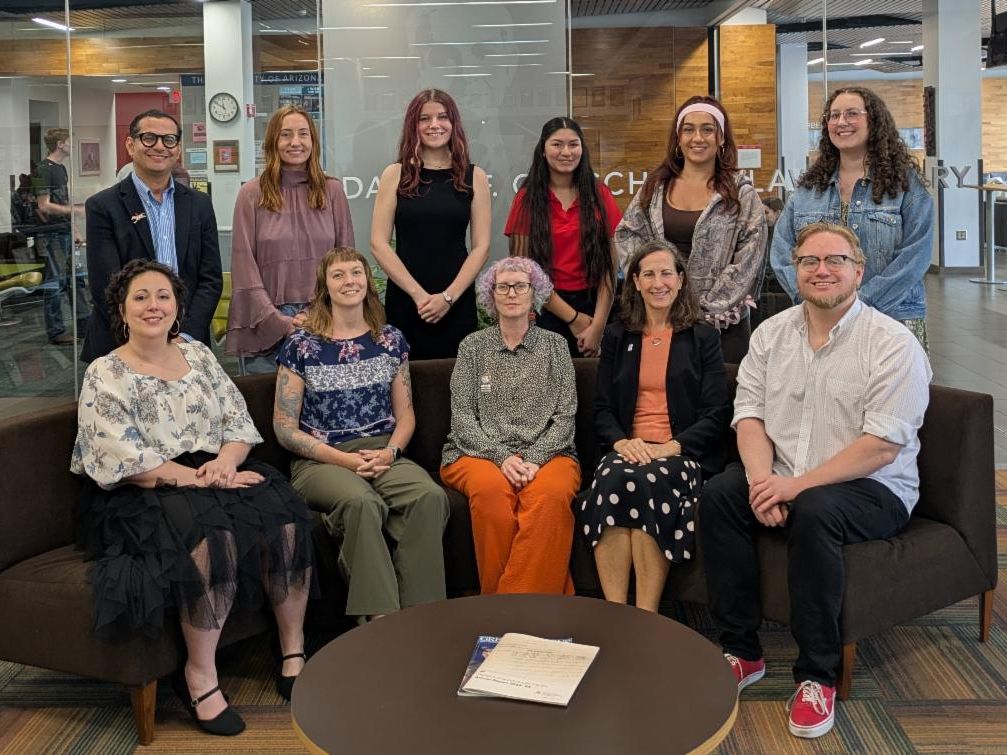
Meaningful engagement with AI cannot be the province of one or two specialists. So, at the charge of law library director Teresa Miguel-Stearns (MLIS ’06) , Cas Laskowski (above, left) drafted a Law Library AI Strategic Plan. The plan is already being implemented, with the team investing in formal training at the 2025 IDEA Institute on Artificial Intelligence, where several earned the Association for Information Science and Technology Foundational AI Certificate.
By early summer 2026, the library launched phase one of its strategic plan, as Laskowski led monthly trainings covering how different AI systems work, their potential uses, and their known issues. In the coming year, the team will study how libraries are using AI to identify potentially applicable workflows, and will draft an internal AI policy aligning all use with the library’s and university’s mission, values and guiding principles. Library Specialist Matt Clemens (MLIS ’24), who recently joined the team, is also employing his AI skills in a variety of collections workflows.
In addition, law student-turned-Law Library Fellow Emily Downs (above, right) worked with Laskowski to update the Law Practice in the Age of AI & Big Data course. In this two-credit experiential course, students develop a technological solution that enhances a hypothetical firm’s pro bono efforts and evaluate and utilize AI tools for risk and case strategy. Laskowski developed a new companion site for the class, built with AI assistance, to deepen engagement for students, particularly those who arrive without technical experience. Downs and Laskowski are also designing an AI upskilling program for law library fellows, giving each a clear path to foundational skills, with optional advanced training where it fits their career goals.
Future of Law Libraries: From Roundtables to Action
In 2023, Laskowski and Miguel-Stearns co-founded a national initiative to explore the role of AI in law libraries, The Future of Law Libraries: Artificial Intelligence, Opportunities, and Advancement initiative. The initiative hosted a series of regional roundtables culminating in a white paper synthesizing the findings from those conversations.
The initiative has now entered its second phase, with three teams of over 50 librarians nationwide drafting the steps necessary to realize the roundtable recommendations. Laskowski leads the four-person Steering Committee guiding this work, with an update due at the end of 2026.
Laskowski’s expertise was in demand well beyond Tucson over the past year, with presentations on AI use at the Arizona Judicial Conference and the Library of Congress AI Literacy & Learning Summit. She also co-wrote a chapter, AI and Machine Learning in Law Libraries, for the book Law Librarianship Practice: Challenges and Opportunities in Law Firm, Government, and Academic Libraries.
Laskowski is serving in advisory roles on AI for the Arizona Judicial Branch, Harvard’s Institutional Data Initiative, and, most recently, she joined the council at Harvard Law School’s Institutional Data Summit.
Law Library Teams Up with Faculty to Leverage AI
The law library team has also begun to explore how AI might become part of our service to the law school community. Laskowski is collaborating with Kristine Huskey, Director of Clinics, to integrate legal AI tools in the college’s clinical programs, giving students critical exposure to tools that they will use in practice upon graduation. Laskowski also leveraged AI vibe coding in her collaboration with Professor Keith Richotte, director of the Indigenous Peoples Law and Policy Program, to build the interactive website for his Supreme Court Indian Law Database.
| 




.gif)